Textile Stories
The Trench Coat and the Architecture of the Trenches
The Most Elegant War Uniform
Few garments have made a more dramatic cultural leap than the trench coat — from the mud of Flanders' trenches to Burberry's Bond Street windows, without changing its silhouette in almost any way. If you're wearing a classic trench coat today, you are wearing, detail by detail, a war survival suit.
Thomas Burberry patented gabardine in 1879 — a revolutionary material made of waterproofed cotton, resilient and, crucially, lightweight. Unlike the heavy rubber previously used in rain gear, gabardine repelled water through textile technology, not chemistry: a tight diagonal weave in which each warp thread passes over two weft threads, creating a compact surface water cannot penetrate, while air circulates freely. Aquascutum also claimed an early similar design, and the rivalry between the two houses fueled decades of innovation in outerwear.
The British Army adopted both versions for officers in World War I (1914–1918), when the trenches of Belgium and northern France combined constant rain, mud, extreme temperatures and toxic gases. An officer spent hours exposed to the elements, with both hands occupied by maps, binoculars or a pistol. The coat had to solve all of this simultaneously.

Every element of the original design was functional and vital. The epaulettes — the rigid pieces on the shoulders — were not ornamental. They held equipment straps, carried rank insignia and, most importantly, anchored the binocular or gas mask strap in quickly accessible positions. The high collars, buttoning up to the chin, blocked wind and battlefield particles.

The chest flap, called the gun flap, was a double layer of material that absorbed rifle recoil when an officer fired from the shoulder — and secondarily directed rainwater away from the chest. Apparently an aesthetic detail, it was in fact ballistic equipment. Without it, every shot would leave bruises on the officer's collarbone after a day of combat.

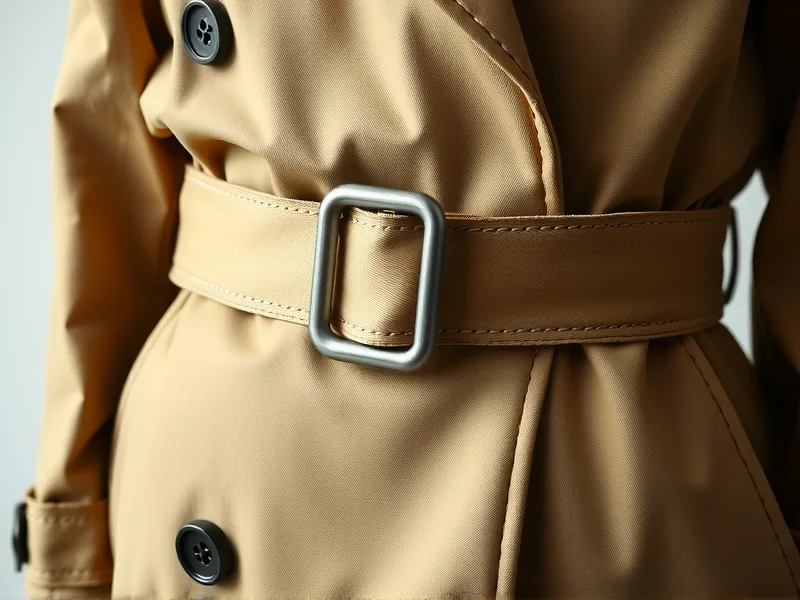
The metal D-rings on the belt were not an aesthetic choice. They served as anchor points for grenades, water bottles, medical kits and other essential equipment. The wide belt straps allowed additional equipment to be hung without carrying a full pack. The back vent and rear half-belt allowed freedom of movement when climbing or crawling through mud — ergonomic details from an era when ergonomics didn't exist as a discipline.
After the Armistice, surviving officers brought their trench coats home. Worn in cities, they conveyed a quiet, familiar authority. The visual code was clear: the man wearing this has seen things. Hollywood understood immediately — Humphrey Bogart in Casablanca, Audrey Hepburn in Breakfast at Tiffany's, then decades of detectives, journalists and spies. Cold War films added the final layer: the trench coat became the unofficial uniform of the secret agent, from James Bond to John le Carré's characters. The military function had disappeared. The mythology remained.

Burberry added the check lining in the 1920s — initially as a practical lining material, later becoming the brand's visual emblem and one of the most copied patterns in fashion history. Today, an original Burberry trench coat sells for several thousand euros. Buyers choose the style for its elegance. Nobody thinks of the D-rings as grenade holders, the gun flap as recoil absorption, or the epaulettes as gas mask supports. Yet all of these are there — functional, intact, useless and eternal.
At Fabrica de Textile, we respect the heritage of every item we produce. Function dictates form. And sometimes, form outlives function by well over a century — transforming a war garment into the most elegant item in the civilian wardrobe.
Curious what we make at Fabrica de Textile?