Textile Stories
Shirt Buttons
Why Men's and Women's Shirts Button on Different Sides
Next time you pick up a shirt, look at the buttons. If it's a men's shirt, the buttons are on the right. If it's a women's shirt, they're on the left. Almost nobody consciously notices this difference, but everyone knows it intuitively — a shirt worn backwards just doesn't feel right. This universal convention, observed by every clothing manufacturer on the planet, has its roots in the Renaissance and a social division that would seem inconceivable today.
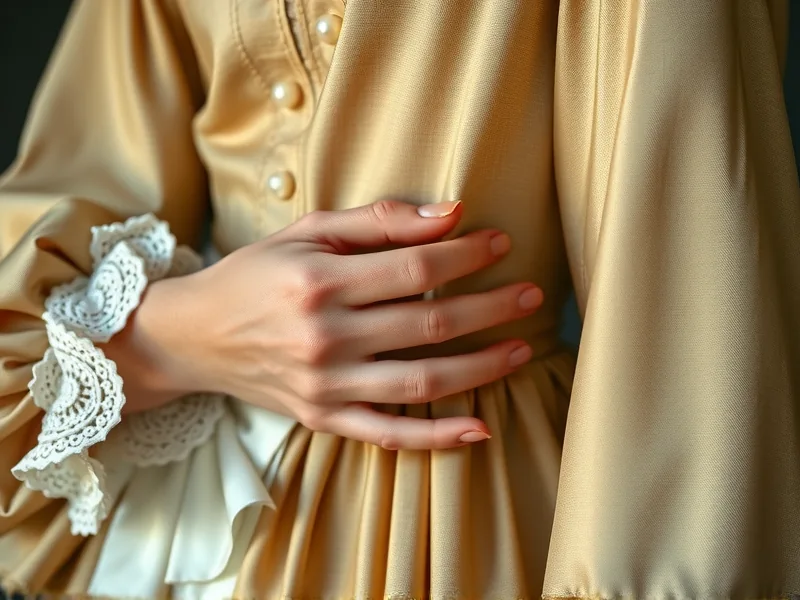
In medieval and Renaissance Europe, a wealthy woman did not dress herself. Ladies-in-waiting and servants — almost always right-handed — dressed her every morning. When a servant stood in front of her mistress and fastened the buttons, a closure on the left (from the wearer's perspective) was on the right from the servant's perspective — the natural, comfortable direction for a right hand. The shirt's design was optimized not for the woman wearing it, but for the woman dressing her.

Men, in contrast, dressed themselves. Buttons on the right allowed a right-handed man to fasten his garment quickly and efficiently, from top to bottom. There was also a tactical reason: knights and duelists wearing cloaks or button-front garments needed to quickly slip their right hand under the jacket to reach their sword. A lapel opening from left to right created a favorable angle for this movement. Napoleon's armies later formalized the convention in military uniform regulations, extending it to a continental scale.


There are exceptions that prove the rule. Women's riding jackets button on the right, like men's — because women riding astride needed to dress and undress themselves without assistance. Women's military uniforms follow the masculine convention for the same practical reason. These exceptions prove the original rule wasn't about gender — it was about who dressed you.

With the Industrial Revolution and mass clothing production in the nineteenth century, the convention was standardized and codified into manufacturing patterns. Factories produced separate patterns for men's and women's shirts, and the button difference became a technical industry standard. It persisted simply because nobody changed it — not from necessity, but from manufacturing inertia.

Today, with more than 90% of clothing production automated, machines are programmed to reproduce this centuries-old convention. Some fashion designers have deliberately tried to break it — the gender-neutral collections of recent years experiment with central buttons or entirely new closure systems. But on retail shelves worldwide, the rule holds. Nobody has servants anymore. Nobody wears a sword at their belt. But shirts continue to remember.

At Fabrica de Textile, we understand that every product detail carries a tradition. When we produce under private label, we reproduce these standards with precision, because they are not arbitrary. They are the memory of the industry — and clients feel them even when they don't know why.
Curious what we make at Fabrica de Textile?